
The Four Requirements for Self-Supported Stage Race Success
I remember the day I stumbled upon the Racing the Planet website. I was planning to move to Finland, so I was looking for an adventure there that I could get excited about. Although I had been running occasionally for several years, I had only completed one trail marathon in Indonesia. The idea of running 250 kilometers (155 miles) while wearing a backpack full of my gear, clothing, and food for a week was both interesting and intimidating. I wanted to become the kind of person who could do such a thing. And, to be honest, I desperately wanted something challenging and a little extreme to throw myself into, because at that moment I was transitioning from life as a single globe‑trotting scuba diving instructor to a deskbound junior software developer and father in Finland. I was craving adventure. I signed up for the race right away, before I could talk myself out of it.
Unfortunately, a multi‑day adventure in my new home country would have to wait; I caught COVID just weeks before the Lapland race and had to drop out. Because that race was a one‑off “roving” event, not to be repeated annually, I set my sights on the Atacama Crossing, another self‑supported stage race organized by Racing the Planet. It would take place the following year in the Atacama Desert in Chile, at around 3,000 meters (10,000 feet) above sea level and in one of the driest places on earth.
The extra time before Atacama meant I could dive deeper into ultrarunning, study everything I could find, and actually implement it in my training. Although I faced some other challenges that year, I still managed to train well enough to finish the Atacama Crossing in 2nd place, feeling strong, injury‑free, and genuinely pleased that, for the most part, everything went according to plan. That experience led me to become a full‑time ultrarunning coach, working with athletes who want to take on similar events.
But even with what I had learned then, and a great race outcome, what I wish I had at the time was a clear framework for what actually matters in these races and what does not. It was only later, through coaching and working with several other athletes taking on similar events, that I was able to piece together the key requirements for success, understand how they interact, and see more clearly what to work on, how to develop them, and when.
The challenge of preparing
The challenge of preparing for a self‑supported stage race is that there’s so much to consider: pack weight, heat, hills, technical or otherwise challenging terrain, the possibility of injuries and blisters, and camp life. On top of that, there’s the uncertainty about how your body will hold up after multiple days of running with a heavy backpack, as fatigue builds, sleep is probably less than optimal, and nutrition choices are limited.
This can all be a little overwhelming. With so many elements to consider, we need to zoom out and look at each issue, then determine how much attention to give it, and when. While many of these challenges are important, most aren’t urgent, and they don’t require much time, attention, or energy to solve. They can be addressed alongside the things that really matter, or at particular moments in your training season. For example, you can set aside time to shop for gear or learn about blister prevention, and plan when you’ll integrate heat training and practicing running with a heavy pack. These things have a time and a place in your season to be worked on, but they are not the most important things.
The four requirements
So, let’s get on to the things that really matter to achieve success in a stage race. Of course, everyone will have their own idea of what success means, whether that’s to get in the top 50, top 20, win their age group, get on the podium, or just finish the damn thing with brain and body still intact. For now, I’m going to define success with the phrase I hear most often from athletes I coach.
“I want to show up fully prepared and do the best that I can.”
There are four requirements every athlete must develop to achieve success in a stage race. You need strong Aerobic Durability to cover the distance day after day; solid Musculoskeletal Durability to withstand the repetitive impact of ground forces and the potential for overuse injuries; a well‑developed Fueling Capacity to maintain a steady supply of energy; and reliable Mental Strength to keep moving forward when it inevitably gets very difficult. Let’s look at each of these requirements in more depth: what they are, why they matter, how to build them in training, and some common mistakes to watch out for.
Requirement 1: Aerobic Durability
It’s no surprise that to perform well in an ultramarathon or multi-day stage race, an athlete requires endurance, which is usually defined in sport as the ability to sustain output over a period ranging from minutes to hours. It’s usually determined by measuring three physiological performance markers:
VO2 max
VO2 max is the ceiling on your aerobic engine: the maximum amount of oxygen your body can take in, deliver to your muscles, and actually use during hard exercise, usually expressed in milliliters per kilogram per minute. A higher VO2 max sets the upper limit for how fast you can ultimately run, even though you rarely race right at that level of intensity.
Lactate threshold
Lactate threshold is the effort level where your body starts producing lactate and other by‑products faster than it can clear and reuse them, so fatigue increases more quickly if you are pushing at threshold effort for too long. In practical terms, it’s roughly the hardest pace you could hold for around an hour, and pushing this threshold higher allows you to run faster and for longer under the threshold.
Running economy
Running economy is a measure of how much oxygen your body uses to hold a given pace. If two athletes have the same VO2 max and lactate threshold, the one with better running economy uses less energy at the same speed and will usually perform better over long distances. In trail and ultra running, running economy still matters, although perhaps a little less than in road running, because you also have to account for how efficiently you move over technical terrain and how well your legs tolerate long climbs and descents over many hours and days.
While those performance markers can tell us a lot about an athlete’s aerobic capacity when they are fresh, they don’t tell us how they will perform when fatigued.
What Aerobic Durability is
Durability has been defined as the time of onset and the magnitude of deterioration in physiological‑profiling characteristics during prolonged exercise. It’s about how long markers of aerobic capacity, like VO2 max, lactate threshold, and running economy, hold up, and to what degree they decline as an endurance event progresses.
This is why two runners with a similar VO2 max, lactate threshold, and running economy can have wildly different ultramarathon outcomes.
It’s why you might know someone who can beat you in a half-marathon, but you can beat them in a 50k. Their aerobic capacity may be higher, but you have more durability.
When durability degrades, we may see a reduction in any or all of the following:
Pace relative to heart rate
Running economy and mechanical efficiency
Power output or normalized graded pace
Subjective level of effort at a given pace
Currently, aerobic durability in trail and ultra running is not easily quantified, but there are a couple of ways to measure it without going to a lab.
Go for a long run at a steady pace well below your lactate threshold, ideally in Zone 1-2. If you have good durability for that duration and pace in those environmental conditions, your training data will show that your normalized grade pace and your heart rate remain closely coupled. If your average heart rate is higher in the second half of your run, while your pace remains the same, then aerobic decoupling has begun. Pa:Hr is the metric in Training Peaks that shows decoupling as a percentage of how much higher your heart rate has drifted above your pace. Generally, a Pa:Hr decoupling of under about 5% suggests you have good durability for that pace and duration in those conditions.
Run the same loop twice in a row at the same rate of perceived effort, and ideally in Zone 1-2, as suggested already. Compare your heart rate and pace data for the two laps. If the second loop is noticeably slower or your heart rate is much higher at the same pace and level of effort, that’s a sign your durability at that pace and duration still needs work.
While it may seem less data-driven, your own subjective feeling of fatigue can be highly valuable. Compare your rate of perceived exertion to your pace. If your pace is slowing, and your effort feels steady, or your pace is steady but maintaining it feels harder, then you’re reaching the limits of your durability for that pace and duration.
Context is always important. Your training is not done in a vacuum or a laboratory. So many factors can affect your ability to express your durability, such as poor pacing, dehydration, underfueling, poor sleep, and other stressors. Even the Pa:Hr value I mentioned can be affected if the elevation profile changes significantly between the first and second halves of the run. One training run is only a single data point. With weeks of training and good notes, you can start to separate out those other influences, notice real trends, and determine whether your aerobic durability is as strong as it needs to be to achieve your race goals.
Why it matters
The more aerobically durable an athlete is, the longer they can maintain a given level of performance before their output begins to deteriorate. In trail running, your aerobic durability will determine how much your performance several hours into a race resembles your performance at the start.
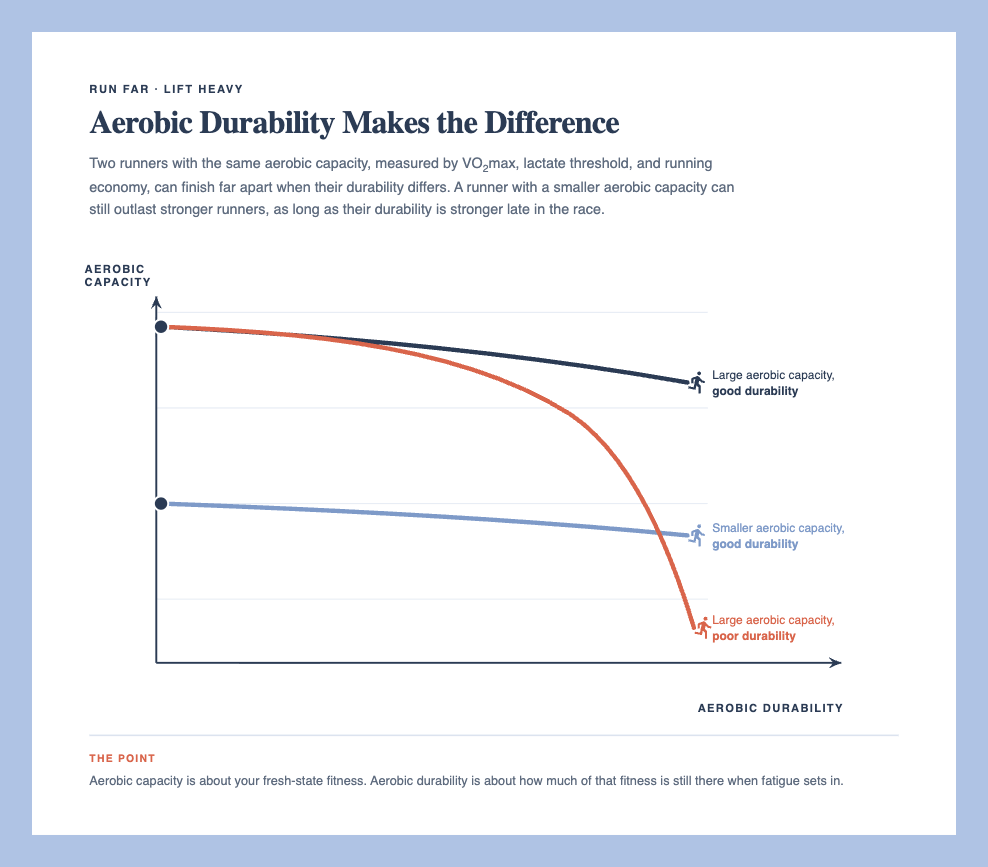
For a multi-day race, your level of durability not only affects how well you finish a particular stage, but also how much each subsequent day’s performance resembles your Day 1 performance when you were fresh. While your ability to recover between stages could be considered another independent measure, perhaps called ‘recoverability’, and it depends on nutrition, hydration, and sleep, it’s highly probable that the same physiological adaptations that improve durability would also improve recoverability.
Of course, no athlete will fully recover between stages; they will start every day pre-fatigued, which means that durability matters more with each consecutive day. For some athletes, their ability to hold their rank, win their age group, or get on the podium will be determined in part by how their durability stacks up against others. For other athletes who are starting with a lower aerobic capacity, a lack of durability means the risk of missing cutoff times is higher.
How to train it
Aerobic Durability is built by:
Consistently running and building up volume over months and years.
Building or maintaining volume during the months leading up to a race.
I understand this can be discouraging if you’re time crunched. This is partly why I always recommend starting training, to some degree, as soon as you can, even if your race is in 3 years. The benefits compound with time.
The first step is to build up weekly running volume. You can start by either adding another day of running per week or add minutes to a few of your runs. If you already have 1-2 hard runs per week, the time you add should be contributed to your easy running volume.
Once you’ve adjusted to the increase in weekly volume, you can increase your long run duration. By this point, you probably have a couple of days of back-to-back running, so the next step is to increase the volume of those days. This could be set up as a long run followed by another day of running at low intensity. You could also do a hard workout with a longer cooldown, for more easy volume, the day before a long run.
Beyond increasing weekly volume and concentrating more volume to a few days, more advanced runners can also layer in runs that include hard intervals toward the end of a long run, which further challenge muscle fiber recruitment when legs are already tired.
What’s important to keep in mind is that it’s not always the right move to add more to everything. If we’re focusing on having big weekends with more concentrated volume, then we may need to back off on other days. Rest and recovery are still important. The adaptation comes from running and recovering, not from being more fatigued more often. Furthermore, there are other training adaptations that you may be working toward, such as increasing your VO2 max or raising your lactate threshold, all of which require you to start those workouts in a somewhat fresh state.
Common mistakes
The most common mistake is that runners don’t build enough overall volume and/or concentrated volume. This is often the case for those who don’t give themselves enough of a runway to safely build volume before their stage race.
Training to improve durability alone can reduce your aerobic capacity. If you only focus on building easy volume, and neglect harder workouts that would improve your VO2 max and lactate threshold, then you will not increase your aerobic capacity. While greater durability reduces the rate of decline from your fresh state starting point, the more aerobic capacity you have determines how high that starting point is.
Poorly structured training or poor execution can hinder your ability to drive other adaptations. As mentioned, aerobic capacity is still important, which means you want to go into your hard workouts relatively fresh so that you can hit the intensities needed to get the stimulus that will drive positive adaptations. If your training plan is set up poorly, or you run too hard on your easy days, then you may end up starting your hard workouts too fatigued, thus unable to get the most out of them.
Requirement 2: Musculoskeletal Durability
In every stage race, it becomes obvious within a couple of days that aerobic durability is not enough to guarantee a strong finish. You might see someone who finished in the Top 10 on Day 2 drop twenty places on Day 3 after encountering debilitating knee pain. Other runners who tried to take the downhills slowly on Day 1 realized on Day 2 that their strategic pacing wasn’t enough to protect their quads, and now the muscle damage they incurred is making every step down noticeably painful. Niggles become pains, each day feels harder and drags out longer than the previous day, and some start questioning whether finishing is possible.
What Musculoskeletal Durability is
Musculoskeletal durability is the term I’m using for how well your muscles, tendons, ligaments, and connective tissues keep functioning under load as fatigue and damage accumulate. They adapt on different timelines, respond to slightly different training inputs, and tend to “fail” in different ways, so it helps to think about muscular and structural durability separately.
Muscular durability
Muscular durability is the ability of your muscles and nervous system to keep producing efficient, economical force for hours, with minimal performance loss, despite accumulating significant muscle damage and fatigue.
Force production capacity over time
This is the ability of your muscles to keep producing force at a steady race effort over several hours. It’s dependent on a continuous supply of energy to the working muscles. You may have experienced this breaking down if you’ve ever had to switch from running hills to power-hiking them, even if the gradients were not getting any steeper.
Resistance to exercise-induced muscle damage
This is how well your muscle fibers hold up after repeated mechanical stress, especially from running downhill. If the damage is too great to recover from quickly, it becomes harder for your muscles to contract effectively and your performance will drop, sometimes for several days.
Neuromuscular efficiency under fatigue
Even if your muscle fibers still have capacity, your nervous system can become so fatigued that it won’t be able to communicate as well to recruit the right muscle fibers at the right time. This reduces your ability to run efficiently and makes technical terrain more challenging and potentially dangerous, because you’re more likely to misstep or trip.
Structural durability
Structural durability is the ability of your tendons, ligaments, and connective tissues to withstand the repetitive mechanical stress of running day after day without breaking down. Tendons connect muscle to bone, and actually help make running more efficient than walking because they store elastic energy when you land and use that energy when you push off the ground. These tendons and the connective tissues around them need to handle enormous repetitive loads. Unlike the other aspects of durability, a lack of durability in some of these structures may result in a more drastic drop in performance, like if an Achilles tendon is ruptured or a stress fracture develops in a metatarsal. Even before things get that extreme, significant tendon pain or bone stress can force you to slow down or stop, even if your aerobic system still feels capable.
When muscular durability or structural durability degrade, any of the following can occur:
Running efficiency declines: stride length unintentionally shortens, ground contact time increases, and the ability to store and use energy is limited, so more energy is used to move forward
Pace slows even though perceived effort stays the same
Running form is altered to avoid pain or to compensate for muscle tissues and tendons becoming too damaged
Certain sections of a course become far more difficult than others, depending on the failure point. A few examples are:
Muscular damage in the quads can make downhill sections more difficult.
Excessive fatigue in the glutes, hamstrings, or calves can make pushing your body up hills increasingly difficult.
Plantar fascia pain can be exacerbated by hard roads.
Stressed lower leg tendons can become more susceptible to injury on uneven terrain.
Why it matters
As the hours of a stage race build up, so does the micro‑damage in your muscle fibers, the fatigue in your nervous system, and the tension and compression on your tendons and connective tissues. The combined effect of these factors, which compound with every hour and every step, can significantly slow your race pace if you lack the muscular durability to handle them.
In multi‑stage races, a large share of the overuse problems that force athletes to slow down or stop involve structural tissues. Lower leg, ankle, foot, and knee tendons and supporting structures simply cannot handle the cumulative load.
Earlier, I mentioned how two runners with a similar VO2 max, lactate threshold, and running economy can have very different race outcomes depending on how good their aerobic durability is. But if they also have similar aerobic durability, the factor that can separate their results is their musculoskeletal durability.
How to train it
Both muscular and structural durability are built primarily through the same work that builds aerobic durability: consistent volume, longer long runs, and back-to-back sessions. They do, however, respond to slightly different inputs and on different timescales.
Consistent volume, long runs, and back-to-back runs
Consistent running volume builds the neuromuscular ability to keep producing force for hours on tired legs. Long runs and back-to-back runs concentrate volume and create fatigued conditions, similar to what you’d encounter in a stage race.
For more advanced athletes with a solid base, occasional short blocks of steady state or tempo effort at the end of a long run can be used to further stress the neuromuscular system under fatigue, but this is a tool to use sparingly, not a weekly requirement. For most athletes, I’d prefer their harder interval work to be done while fresh, so they can hit the intensities required to drive other capacity-building adaptations, such as improving VO2 max or lactate threshold.
While muscles can adapt in weeks, connective tissues like tendons, ligaments, fascia, and bones can take much longer, sometimes months and even years. As mentioned, consistent running volume is the key driver of connective tissue adaptations, but it’s important that the volume is progressively increased at a safe rate, so that these tissues have time to catch up with the other systems.
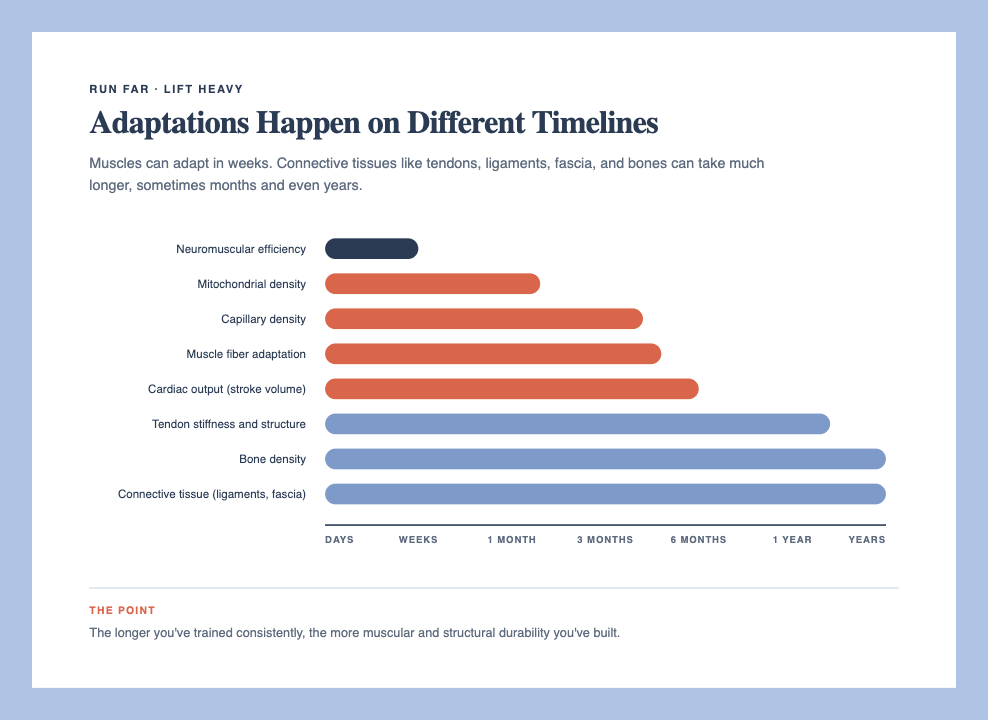
The 10% rule has often been used as a guide for how much to safely increase volume week over week. More recent research has suggested that, if you use the 10% rule at all, it may be more useful to apply it to the duration or distance of the long run than to the total duration or distance of the entire week.
Downhill and terrain-specific training
One of the best things you can do to train for your stage race is to run in conditions and on terrain that look like your race. Your neuromuscular system gets more tuned in and efficient on the specific terrain you practice on, especially when you repeat it over weeks and months. Ideally, you’d target a rate of ascent for the distance that matches your race. For example, if your race has about 200 ft of ascent per mile (around 40 m per kilometer), try to run your long runs, and at least one weekday run when possible, with a similar profile. To prepare for the climbs and descents you will encounter, train on hills with similar gradients. This lets you practice the specific “mode” you’ll use on race day, whether that’s running or hiking, and, if you’re using poles, you can practice the techniques you’ll use at different gradients and paces.
If it is hard to find hills where you live and you lean on a treadmill for elevation gain, still try to seek out some real hills to get the downhill training effect your tendons and muscles, especially your quads, need to handle the pounding. Downhill running creates a lot of eccentric muscle damage, but it also triggers the “repeated bout effect,” where just a few well-spaced downhill sessions make the next similar session less damaging. In practice, this means that every few weekends you can go find some hills and gradually build up your downhill minutes, and you make sure you include one of these weekends in the final 3 to 6 weeks before your race without cramming all the descent work at the very end.
Strength and plyometric training
Strength training with heavy weights can improve running economy by strengthening the neuromuscular communication needed for your legs to produce force on demand for several hours. It also increases muscle–tendon stiffness, which allows you to produce more force with less effort. Stronger, stiffer tendons and connective tissues can handle more load and repetitive impact, and the chances of developing an overuse injury can be reduced, though never completely eliminated. A well‑designed strength program includes compound movements like the squat, hinge, push, pull, and carry, as well as exercises that build core strength, strong ankles and hips, and single‑leg stability and strength.
Plyometric movements like hops, bounds, and small jumps improve neuromuscular coordination, and faster plyometric drills in particular teach your lower legs how to store and release energy quickly, just as they need to while running. Because plyos place high stress on your calves, Achilles, and feet, they should be introduced gradually in low volumes and built up slowly over time. Even just a few sets per week can be highly beneficial, and they can easily be worked into a strength training session, as part of a running warm‑up, or on their own if that is more convenient.
Common mistakes
Doing too much too soon. The most common case of this is increasing running volume too quickly. Restraint can be difficult for ambitious and determined ultrarunners, especially if at some point in the past, they trained with much higher volume. While long-term training history is valuable, more recent training, like in the previous weeks and months, is what really should determine your weekly training volume. Again, the mind, the aerobic system, and even the muscular system might all be ready to increase the load, but the connective tissues might not.
Doing too much too soon can also include increasing the rate of ascent drastically, increasing downhill minutes too quickly, doing too much strength training to the detriment of the running workouts, and even doing more advanced or unnecessary plyometrics.
Overly relying on strength training or cross-training instead of running volume. In the past, I might have written that neglecting strength training was a common mistake. Nowadays, most runners are catching on that strength training is highly beneficial, but the truth is it still cannot replace running. Since most athletes have jobs, families, obligations, and other interests, and therefore limited training time, the hours need to be allocated to what will benefit the athlete the most. Most runners will get enough of a sport-specific training benefit from strength training under a couple of hours per week.
Cross-training, such as indoor cycling or riding the elliptical, can be useful for a runner who is either injured, recovering from an injury, or wants to add more weekly training volume without the ground force impact and mechanical stress of running. But for most uninjured athletes with limited training time, they’ll get the specific muscular and structural training adaptations to become a better runner by simply running.
Doing only high-repetition low weight or bodyweight strength training. This may be a good way to get started with strength training, but to really create a stimulus that drives tendon adaptations and promotes good motor unit recruitment, at some point you need to lift heavy. “Heavy” will look different for each athlete, but for most runners it usually means sets of fewer than about 10 reps. If a set feels challenging and you could only do a few more good‑quality reps at the end, you are probably in the right zone.
Requirement 3: Fueling Capacity
As the days wore on during the Atacama Crossing, while many competitors were finding their limits of aerobic durability or musculoskeletal durability, a third limiter was also becoming increasingly obvious, and its impact was noticeable throughout the camp. Many competitors were battling gastrointestinal issues that threatened their ability to keep moving forward. Nausea, vomiting, bloating, abdominal pain, diarrhea, and dehydration were far more than just uncomfortable symptoms to manage in a camp environment; they also affected a competitor’s ability to get what they needed most: fuel and hydration.
What Fueling Capacity is
Fueling Capacity is the ability to consume, absorb, and utilize enough calories and fluid during each stage of a multi-day race to sustain performance and recovery.
To fuel and hydrate well during a race, you need three things working together:
Carbohydrates
Carbohydrates are your go-to source of fuel during a stage, because your muscles can use them quickly. For most runners going longer than a couple of hours, that usually means getting somewhere in the 40–90 g per hour range, depending on your pace, terrain, and how well your gut is trained to handle fuel.
Fluid
Fluid is what keeps blood volume up, sweat flowing, and your gut able to do its job. Many ultrarunners end up drinking roughly 400–800 ml per hour on the move, and some high‑sweat athletes in hot races might push higher, but the goal is always the same: avoid getting very dehydrated without tipping over into overdrinking.
Sodium
Sodium is the main electrolyte you lose in sweat, and it helps you hang on to the fluid you’re drinking and reduces your risk of hyponatremia when you’re out there for hours. A simple starting point is aiming for about 500–800 mg of sodium per liter of fluid, then adjusting up or down based on how salty you are as a sweater and how hot your race is.
Why it matters
Your fueling capacity during a stage race will be challenged by heat and intensity. When it is hot or your muscles are working hard, which is likely in a stage race, your body diverts more blood to your skin to keep you cool and to your legs to keep you moving. The stomach and intestines get less blood flow, digestion slows down, and your risk of gastrointestinal distress goes up.
Even if you have trained your gut well before the race, your fueling capacity is still limited by the strategy you use on the day. A poor fueling and hydration strategy, or drifting too far from the approach you tested in training, can undermine the capacity you built. Intra‑stage fueling (eating and drinking while moving) is often the most important and the easiest to get wrong, but inter‑stage recovery nutrition (what you eat and drink between stages) is just as important because it directly affects how well you recover from one stage and replenish glycogen stores for the next.
During a stage race, you will inevitably end up in a caloric deficit, even if you are fueling at the higher end of the spectrum. You simply cannot replace every calorie you burn in real time, and limited time between stages and limited food supply make it hard to fully replenish your glycogen stores. The goal is not to stay perfectly balanced, but to keep that deficit as small as it needs to be. A good fueling capacity lets you make the most of the calories and fluid you do have access to. If you want help turning these ideas into a concrete pacing, fueling, and hydration plan, the Stage Race Planner is a tool I built for exactly that.
How to train it
You train fueling capacity by gradually teaching your gut to handle the carbs, fluid, and sodium you’ll need during each stage, then practicing that plan in your long runs.
Find your hourly targets.
Carbohydrates. If you are just getting started with fueling during runs, begin with around 30 g per hour and gradually work your way up toward 60 g per hour as your gut allows. Once you are comfortable there, you can test up to about 90 g per hour, especially if you plan to run most of the stages rather than hike large portions. Use products that give you a mix of glucose and fructose, especially above 60 g per hour, so you spread the work across multiple transporters instead of overloading one pathway and upsetting your gut.
Fluid. To get a rough idea of your fluid needs, do a simple sweat test in conditions and at an effort level similar to what you expect in your race. Weigh yourself before and after a run, track what you drink, and see how much you actually lose per hour. Most runners will end up drinking somewhere in the 400–800 ml per hour range, which usually replaces about half to three‑quarters of their sweat loss. Even if your sweat rate is closer to 1.0–1.2 L per hour, your gut may not be able to comfortably absorb all of that, so use training to find the highest intake that feels sustainable rather than trying to match every drop of sweat.
Sodium. A simple starting point is to aim for roughly 500–800 mg of sodium per liter of fluid and then adjust based on how salty you are as a sweater and how hot your race is. If you finish long, hot runs with heavy salt crusts on your clothes and face or you tend to cramp when you drink a lot of plain water, you may feel better closer to 1,000 mg per liter, but that is something to test in training, not during your stage race.
Practice eating and drinking products you intend to race with during your training runs.
While some very easy low intensity runs may not require much or any fueling to support performance during the run, it makes sense to fuel anyways if you are trying to train the gut. It will be during your long runs where you really train the gut and experience what it feels like to fuel well or not. Most runners can survive a couple of hours of running with inadequate fueling, but during a 4-5 hour run, you will notice a couple of things.
How well your gut handles the steady supply of calories and fluid for multiple hours.
How well you are able to perform with the fueling and hydration plan you have.
Train in environmental conditions similar to those of your race.
Heat, humidity, and very cold weather can all affect your ability and desire to eat and drink. Whenever possible, run in conditions you expect to encounter, and train your gut by eating and drinking regularly, even if you don’t feel like it.
Practice eating and drinking on a schedule.
Even when it’s not hot or cold, you may not really feel hungry or thirsty while running. In fact, if you do, it might be too late. To prevent yourself from falling behind and potentially digging a hole you can’t climb out of, make a plan to eat or drink on a schedule. For example, you can take a drink every 5 minutes and a gel every 20 minutes, if that’s what you’ve determined will allow you to hit your hourly targets, as discussed earlier. It’s much more effective and easier on your gut to consume smaller portions of food and fluid more frequently than to force down your hourly targets all at once.
Common mistakes
Intentionally underfueling. This is often the result of wanting to have a lighter pack. For some athletes with a history of back problems or other injuries, the lightest pack possible may be what’s necessary for them to complete the race. But for athletes without those added challenges, the strategy of taking as little food as possible to hopefully race faster is a gamble I wouldn’t advise taking. As mentioned, a caloric deficit will be unavoidable by all, but I recommend giving your body the best possible chances to perform well. The challenge of carrying a heavier pack can be mitigated with proper training.
Eating and drinking when you feel like it. It’s tempting when you are feeling good and running well to just keep going; you may not want to rock the boat. But, as mentioned, we cannot completely trust our hunger and thirst cues, and by the time they come and we decide to eat or drink, it may be too late, and the deficit may be too big to recover from.
Getting carb mixes wrong. While carb drink mixes are a popular choice for stage races because of the weight savings, they depend on your carbohydrate, fluid, and sodium needs to all stay steady throughout your race. They can work perfectly if you are racing in moderate temperatures and can consistently consume the right amount of carb mix to hit your three needs: carbohydrates, fluid, and sodium. But if you’re in a desert race, you may need to consume more fluid and sodium, but not necessarily more carbohydrates. And, of course, consuming more carbohydrates than your gut can handle can lead to gastrointestinal distress. So, to make a carb mix work in a hot race, you might need to keep a back-up fluid source that does not contain carbohydrates. And, if the opposite situation happens, in which your fluid needs drop, like they may in a very long stage, you’ll need an alternative source of carbohydrates, like gels, to keep fueling if you’re not drinking much carb mix.
Requirement 4: Mental Strength
It may not come as a surprise that mental strength is one of the requirements for succeeding in a self-supported stage race. Most athletes agree it’s necessary for taking on endurance events, and some will go so far as to say that it’s all you need to complete an ultramarathon. I can see why many would believe this. Many of those who crossed the finish line on the last day of the Atacama Crossing had suffered through enormous fatigue, grueling pain, and unrelenting stomach problems, but their incredible mental strength allowed them to push through and finish their race anyways. So while it’s possible to complete a stage race using mental strength alone, you will also need aerobic durability, musculoskeletal durability, and fueling capacity to succeed in a stage race, which I defined earlier as showing up fully prepared and doing the best you can.
What Mental Strength is
Mental strength is partly your capacity to handle discomfort, pain, and setbacks without falling apart, and partly how quickly you can return to your baseline when you do crack.
Capacity to handle negative events
This is how much discomfort, pain, frustration, and adversity someone can handle before their confidence and clarity drop from their baseline, which could affect decision making. In the context of ultrarunning, negative events can include fatigue, injury, gastrointestinal distress, equipment loss or failure, challenging weather, logistics or planning errors, feelings of uncertainty, as well as any underlying issues that are not directly related to the race.
Speed of recovery after a drop from baseline
After someone has exceeded their capacity for handling negative events and their confidence and clarity have dropped, this is how quickly they can recover and get back to a more stable, useful headspace. In practice, it’s the ability to notice the drop, reset, and refocus so they can make good decisions after a low point. This is essentially resilience.
Why it matters
During your stage race, you need enough confidence and clarity that, despite the many challenges you face, you still believe you can achieve your goal and you keep making decisions that support that goal.
What makes self-supported stage races so uniquely challenging is the number of different stressors involved, and the compounding effect they can have over multiple days. Of course, running with a heavy backpack for several hours per day is incredibly taxing, but adverse weather conditions, limited food options, poor sleep, and the inherent challenges of camping are also stressors that can affect an athlete’s mental strength, and their ability to problem solve or stay motivated.
Athletes with little mental strength are more likely to be knocked down by smaller issues. They may catastrophize, inflate difficult moments, and get overwhelmed. If too many challenging moments add up, and they stay in a negative mental state for too long, they may feel the challenge is unbearable, and might decide to drop out.
One way to think about this is to imagine both your mental strength and the challenges you face on a simple 1–10 scale. A small stumble where you bang your knee and get dirty might be a 2 out of 10 problem. If your current mental strength is at a 1, that little fall can ruin your day and maybe your race. At the other end of the spectrum, going off course and running in the wrong direction for four hours might be a 9 out of 10 problem. If your mental strength is closer to a 10, you still will not like it, but you will be able to respond more calmly, adapt your plan, and stay focused on your goal instead of falling apart.
How to train it
Increase your exposure to challenges.
Fortunately, while you are putting in hundreds of hours of running over several months, you'll also have the opportunity to train your mind. You build your confidence, resilience, and mental strength by completing challenging workouts, long runs, and back-to-back training days, sometimes under less-than-ideal conditions and often carrying some fatigue or stress from other parts of your life. You have difficult experiences in training and you learn how to solve problems. You run on hot days. You run in the rain. You trip, get banged up, and keep going. You get nauseous, get lost, your phone dies, or your hydration bladder breaks. You’ll get better at handling challenges, and if you’re intentional, you’ll get better at handling them while staying calm.
Commit to your plan.
I have found that the very simple practice of completing my long run as planned has helped develop my mental strength. Let’s say my target long run duration one weekend is 4.5 hours, and for whatever reason, I don’t really feel like it. That morning during breakfast and even as I get started running, the reasons why I could cut it short start to surface and the negotiations begin. “In several months of training, it’s not a big deal to cut this one run short an hour.” “Plenty of other people are not running this much - you’ll be fine with less volume.” Eventually I close the door to any option other than completing the long run as planned, not because those statements aren’t valid; they may be, but I also know that every time I follow through on what I set out to do, I build not only mental strength, but also self-trust, which really could be a precursor to mental strength. It’s easier to handle bigger challenges when you trust yourself.
Develop mental strategies.
I’ve written about mental strategies in this blog post, so I won’t repeat myself too much here, other than to say mental strategies are highly valuable yet underutilized tools you can practice with during your training runs, so that you can easily call on them when needed during your races. Think of them as perspectives you can choose to adopt and run with. Negative thoughts may enter your mind at some point during your stage race. It’s much harder to remove them if you don’t have anything to replace them with.
Common mistakes
Only visualizing positive outcomes. There can be some benefit to imagining yourself crossing the finish line victoriously several months before you even set foot on the race course, but what’s significantly more useful is to visualize yourself implementing your race strategy, which includes everything you will do before, during, and after each stage. Then visualize yourself encountering specific problems along the way, like getting a blister, feeling nauseous, taking a wrong turn, or encountering ankle pain. Think through not only how you would solve them, but also picture the calm mental state in which you would solve them.
Thinking you have more mental strength than you really do. Mental strength can feel like a squishy component, with no obvious way to measure it, but your training history gives you some clues. One place to start is your workout calendar: over the last few months, how often did you follow through on the sessions you planned, and how often did you skip or cut them short when you could have done them? Life is complex and we all miss workouts for good reasons, but most athletes can look back and see a few times when they simply did not want to do the hard thing. Noticing those patterns is useful feedback. Going into a stage race with an inflated sense of your mental strength, without the training to back it up, is likely to lead to a rude awakening out on course.
Not training mental strength in daily life situations. For most of us, challenging situations show up regularly in daily life. The scope and duration of those challenges will vary from person to person and season to season, but each one can be an opportunity to practice responding calmly and intentionally. To be honest, I’ve often felt it working the other way around for me: my mental strength in ultrarunning is pretty good, and I frequently feel that training is what prepares me for real life, where I’m still very much a work in progress.
How the four requirements work together
I hope I’ve made it clear how Aerobic Durability, Musculoskeletal Durability, Fueling Capacity, and Mental Strength are all requirements for self-supported stage race success. If you are missing any one of these, you may still complete your race, but if you really want to perform at your best, you’ll need to train all four components.
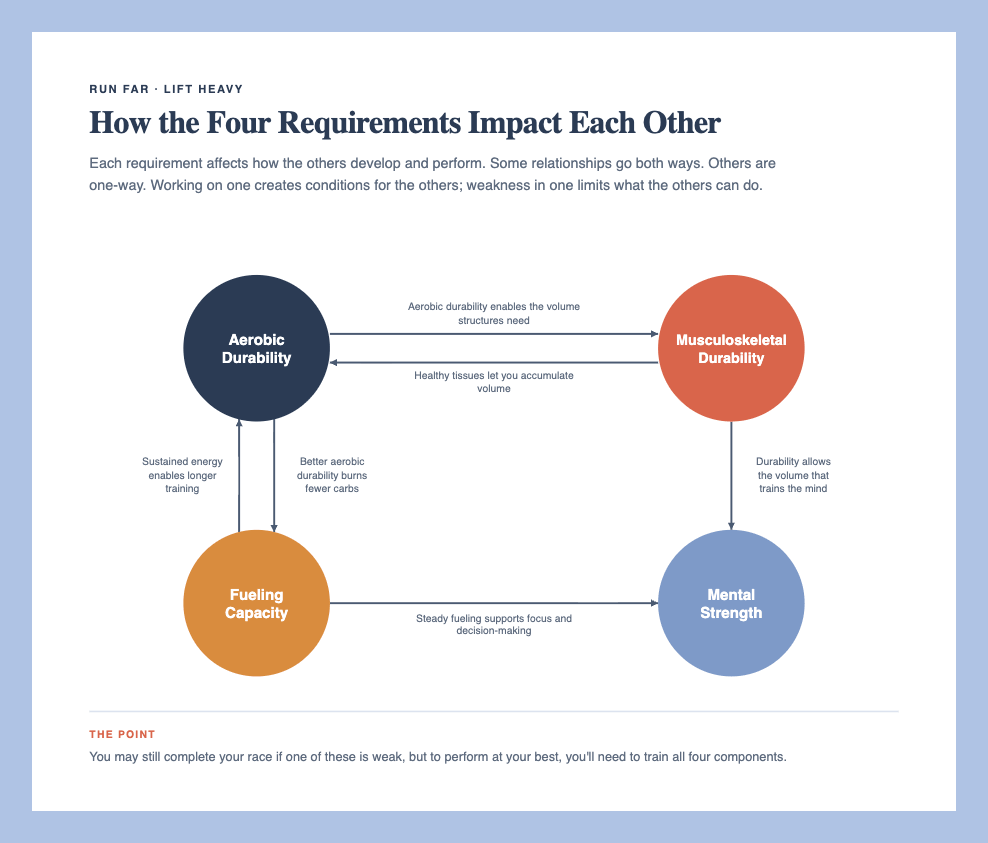
While we’ve looked at each of these independently, you’ve probably noticed how they relate to each other and, to a degree, develop alongside each other. There’s no need, and it wouldn’t make any sense, to work on one at the exclusion of the others. In fact, they should all be worked on at all times, as the development of each of them supports development of the others.
Aerobic Durability and Musculoskeletal Durability are both primarily developed by consistent running volume, week after week for months and years. However, if an athlete has very poor Musculoskeletal Durability, such as tendon pain, recurring niggles, or persistent stiffness, they may not be able to accumulate enough volume to improve their Aerobic Durability. Furthermore, the lack of movement efficiency from weak muscles, painful joints, or tight tendons increases the metabolic cost of running, which reduces Aerobic Durability.
On the other hand, if Aerobic Durability is the weak point that limits a runner’s ability to increase training volume or run for longer durations, then tendons, bones, and connective tissues will have less exposure to the ground impact forces needed to stimulate meaningful adaptations to Musculoskeletal Durability.
Interestingly, it’s often because of a lack of Aerobic Durability, Musculoskeletal Durability, and Fueling Capacity that Mental Strength is sometimes developed first. I still remember how much mental strength I had to summon to complete my first 3‑hour long run. I had a small aerobic capacity, my knees ached from the repetitive pounding on asphalt, and I was incredibly dehydrated. Of course, that doesn’t mean that’s the best way to build mental strength. In fact, when those three other components are more developed, training volume, and specifically long run durations, can increase, which also increases exposure to adverse conditions and situations. Mental Strength then has more opportunities to be trained and improved.
When Fueling Capacity is more developed, it means more energy can be supplied more steadily and for longer to the working muscles, which allows you to increase training time. That extra time, as mentioned, is needed to develop Aerobic Durability and Musculoskeletal Durability. On the flip side, if an athlete improves Aerobic Durability and Musculoskeletal Durability, they become a more efficient runner and can operate at a lower relative intensity for the same pace. That means relatively more blood flow can be directed toward digestion and absorption, which can increase Fueling Capacity. An athlete with more Aerobic Durability can also burn fewer carbohydrates at a given intensity, which makes it easier to keep up with their fueling needs.
A runner with a good Fueling Capacity will be better fueled and hydrated, which can improve Mental Strength. That correlation may not always be obvious, but we know the opposite to be very true. Most people, whether running or not, show a visible loss of Mental Strength when they are hungry or dehydrated, and they’re less equipped to make good decisions, tolerate pain, or manage their emotions.
On starting early
There was one part of this whole process I didn’t fully appreciate until long after I missed my opportunity to join the Lapland race: how much time actually matters. In the lead up to the Atacama Crossing, it became clear how much can happen between signing up and standing on the start line: moves, job changes, illnesses, injuries, family shifts, and stretches where training just doesn’t go to plan. My training was far from perfect, but starting early gave me enough runway that the work I had done over the preceding years still added up. That’s why it makes sense to start preparing for your race as soon as you realistically can, even if it feels far away. With enough time, you’ll still make progress when things don’t go as planned. You may also discover, like I did and many others have, that with enough intentional training over time you’re capable of performing much better than you once thought. Your idea of success, and of “the best I can do,” may get upgraded.
Knowing where you stand on each requirement is more useful than just reading about them. I built the Stage Race Readiness Assessment so you can find out where you stand and your top three priorities to focus on next. It takes less than 10 minutes, and gives you a clear starting point for your training.
References
Balducci, P., Clémençon, M., Morel, B., Quiniou, G., Saboul, D., & Millet, G. Y. (2017). Physiological characteristics of master athletes in mountain ultramarathon. European Journal of Applied Physiology, 117(11), 2209–2216.
Maunder, E., Plews, D. J., & Laursen, P. B. (2021). The importance of ‘durability’ in the physiological profiling of endurance athletes. Sports Medicine, 51(8), 1619–1628.
Maunder, E., Kilding, A. E., & Plews, D. J. (2025). Durability as an index of endurance exercise performance: methodological considerations for researchers and practitioners. European Journal of Sport Science.
Meixner, J. M., Joyner, M. J., & Sperlich, B. (2025). Durability, fatigability, repeatability and resilience in endurance sports. Sports Medicine.
Scheer, V., et al. (2024). Physiology and performance in multi‑stage ultra‑marathons: a systematic review. Frontiers in Physiology.
Beattie, K., Preece, S. J., Pulford, R., & Burnie, L. (2017). The effect of strength training on performance in endurance runners: a systematic review and meta‑analysis. Sports Medicine, 47(8), 1697–1716.
Hoffman, M. D., & Fogard, K. (2012). Factors related to successful completion of a 161‑km ultramarathon. International Journal of Sports Physiology and Performance, 7(1), 25–37.
Millet, G. P., Banfi, J. C., Kerherve, H., Morin, J. B., & Vincent, L. (2011). Physiological and neuromuscular changes after a 166‑km ultra‑marathon. International Journal of Sports Medicine, 32(5), 397–402.
Scheer, V., Vieluf, S., Wolfarth, B., & Knechtle, B. (2020). Musculoskeletal injuries in multi‑stage ultra‑marathons: a systematic review. Frontiers in Physiology, 11, 567708.
Spurrs, R. W., Murphy, A. J., & Watsford, M. L. (2003). The effect of plyometric training on distance running performance. European Journal of Applied Physiology, 89(1), 1–7.
Zanini, L., et al. (2025). Strength training improves running economy durability and fatigued high‑intensity performance in runners. Medicine & Science in Sports & Exercise.
Zanini, L., et al. (2026). Regular long runs and higher training volumes are associated with better running economy durability. European Journal of Sport Science.
Costa, R. J. S., Miall, A., Khoo, A., Rauch, C., Snipe, R., Petersen, C., & Gibson, P. R. (2017). Gut‑training: the impact of two weeks repetitive gut‑challenge during exercise on gastrointestinal status, glucose availability, fuel kinetics, and running performance. Applied Physiology, Nutrition, and Metabolism, 42(5), 547–557.
Jeukendrup, A. E. (2017). Training the gut for athletes. Sports Medicine, 47(1), 101–110.
Stuempfle, K. J., & Hoffman, M. D. (2015). Gastrointestinal distress is common during a 161‑km ultramarathon. Journal of Sports Sciences, 33(17), 1814–1821.
Tiller, N. B., Roberts, J. D., Beasley, L., Chapman, S., Pinto, R., Smith, L., & Vargas‑Merino, E. (2019). International Society of Sports Nutrition Position Stand: nutritional considerations for single‑stage ultra‑marathon training and racing. Journal of the International Society of Sports Nutrition, 16(1), 50.
Buman, M. P., Omli, J. W., Giacobbi, P. R., & Brewer, B. W. (2008). Coping and self‑regulation in ultra‑marathon runners. Journal of Applied Sport Psychology, 20(3), 337–355.
Henshall, C., et al. (2022). Mental toughness in ultra‑endurance athletes: a systematic review. International Review of Sport and Exercise Psychology.
Meijen, C., Turner, M., Jones, M. V., Sheffield, D., & McCarthy, P. (2020). A theory of challenge and threat states in athletes: a revised conceptualization. Frontiers in Psychology, 11, 126.
Millet, G. P. (2011). Can neuromuscular fatigue explain running strategies and performance in ultra‑marathons? The flush model. Sports Medicine, 41(6), 489–506.
Schiphof‑Godart, L., Hettinga, F. J., & Roelands, B. (2018). Pacing in ultra‑endurance events: distribution of exercise intensity and the role of psychophysiological factors. Sports Medicine, 48(8), 1761–1776.